
The Fatal Cost of Not Listening: Medical Mistreatment and Indigenous Maternal Morbidity
A poster exploring medical mistreatment of Indigenous women and the impact it has on Indigenous maternal mortality.
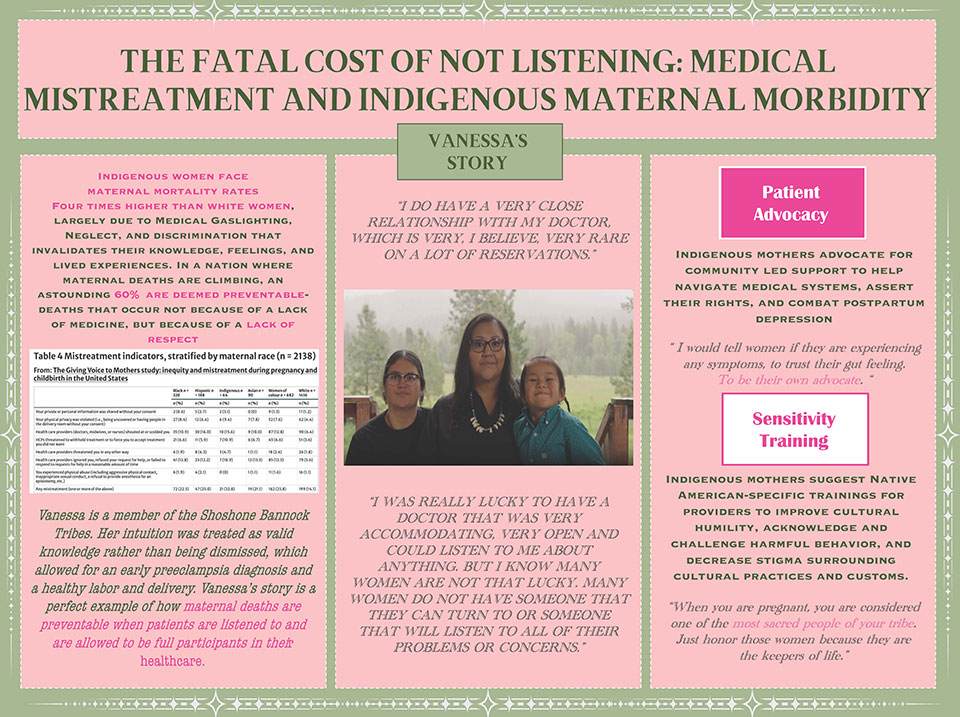
Indigenous women face maternal mortality rates four times higher than white women, largely due to medical gaslighting, neglect, and discrimination that invalidates their knowledge, feelings, and lived experiences. In a nation where maternal deaths are climbing, an astounding 60 percent are deemed preventable deaths that occur not because of a lack of medicine, but because of a lack of respect. By combining qualitative research, national data, and personal narrative, this poster aims to show that Indigenous maternal morbidity is not inevitable; it is produced.
Artist
Edinelly Peguero Rosario (2026)
Artist Lens
In this poster, I approach Indigenous maternal health through the lens of listening—who is heard, who is dismissed, and what it costs when medicine refuses to honor lived experience. My poster is not only an academic exploration of maternal mortality disparities, but a visual argument that respect is a life-saving intervention. I center my work on Vanessa Sanchez’s story from the CDC’s HEAR HER campaign because her experience reveals a powerful paradox. Vanessa survived preeclampsia not because of advanced technology or extraordinary intervention, but because her doctor listened. In a system where Indigenous women are four times more likely to die from pregnancy-related causes, her survival becomes both hopeful and unsettling. It forces us to ask: why is respectful care rare enough to be described as “lucky”?
My project focuses specifically on obstetric gaslighting—the denial of mothers’ humanity, knowledge, rationality, and feelings within clinical encounters. Research describes this as structural violence embedded in modern obstetrics, but I wanted to make that violence visible not through abstraction, but through contrast. Vanessa’s quotes sit at the center of my poster because the very act of centering her voice challenges the systemic silencing Indigenous women experience. Her words are not decorative captions; they are the foundation of the piece. By enlarging and isolating her statements, it visually disrupts the hierarchy that typically privileges clinical authority over patient experience. The layout itself reflects this argument. I placed statistics on the left to represent the weight of systemic inequity, the data that quantify Indigenous maternal mortality, preventable deaths, and documented mistreatment. Numbers establish urgency, but they can also distance us emotionally. On the right, I positioned community-led solutions and calls for culturally specific provider training. This placement creates a visual movement: from harm, to voice, to possibility. The center holds Vanessa’s story as the bridge between these forces—proof that outcomes change when power shifts.
Through this poster, I argue that the crisis is not rooted in a lack of medicine but in a lack of respect. Ultimately, my project asks viewers to reconsider what counts as expertise. When Indigenous mothers say something is wrong, they are not being emotional; they are offering embodied clinical insight. Listening is not passive. It is policy. It is practice. And for many Indigenous women, it is the difference between life and death.
Media
Digital
Download The Fatal Cost of Not Listening: Medical Mistreatment and Indigenous Maternal Morbidity PDF