
Re-Imagining Homelessness in Mass. and Cass
A microsite that reimagines Boston’s Mass. and Cass, the area with the highest homelessness rate in the city, to combat the harms of homelessness.
Homelessness is a major public health issue in the United States. Homeless individuals are at critically higher risk for health issues such as malnutrition, HIV, violence/rape, substance abuse disorder, and mental illnesses such as anxiety/depression. Homeless youth have triple the chance of becoming pregnant, and homeless individuals have an overall 1600% higher mortality rate. In Boston, the 14th largest homeless-rate city in the U.S., 1 in 8 people are homeless and the number increased 17.2% from 2022 to 2023. Mass. and Cass, also known as “Methadone Mile” or “Recovery Road,” is a collection of neighborhoods that one may encounter when stepping off of an MBTA bus, at the Massachusetts Avenue and Melnea Cass Boulevard intersection. For a long time, it was a tent city and open-air drug market in the depths of industrial Boston, known as an “epicenter” for New England’s growing opioid crisis. It is the area with the highest homelessness rate in Boston. This project hopes to reimagine what Mass. and Cass may look like—and more importantly, how its people may interact with the space.
Artist
Emily Xing (2024)
View Re-Imagining Homelessness in Mass. and Cass: Sketches of a Space Worth Knowing Microsite


Artist Lens
Growing up in Baltimore, I had always seen neighborhoods that people told me to “stay away from” because of drugs and homelessness. However, once I went to school and actually met many people from these neighborhoods, I realized that they needed the most care, attention, and respect; my best friend was a girl who was working 3 jobs to support her sister’s surgeries after they immigrated from Ecuador. Too often, we fail to see the inherent marginalization of poor and POC communities in our systems, from the readily available resources nearby to unclean living spaces that perpetuate cycles of disease. In particular, I’ve realized how intertwined our homes and personal health are—poor housing, pollution exposure, and access to resources all affect health outcomes such as depression, anxiety, injury/trauma, disease, etc. Moving from Baltimore to Boston, I saw a lot of similar homelessness, and I chose to focus on raising awareness around Mass. and Cass, where Boston’s homelessness is most concentrated, as an extreme example of an area embodying the system that has failed our homeless population.
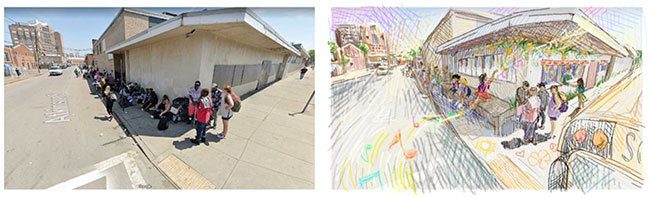
I wanted to publish an emotional photo essay that would touch both the general public and policymakers and change the way they thought about Mass. and Cass, and homelessness in general. First, I provide background to this area, making people aware of its history and issues. I chose to include my sources as hyperlinks which is classic in social journalism in order to make accessing resources easy for my audience. Then I discussed current projects surrounding re-imaging it: what if the area these people lived in had more green spaces? What if there were more community-based resource centers to host group recovery workshops and therapy sessions? What if their care facilities and shelters were more just and cultivated more supporting social relationships? Then Mass. and Cass could no longer embody the illnesses the public associates with it. I chose to incorporate art into my multimedia project in creating visions for the outcomes of these hypotheticals, consisting of happier and more active communities, because art is not only a powerful visual tool for change, but also easy to understand for the public and policymakers. The realistic and re-imagined side-by-side comparison speaks to our emotional sides of “what could have been.” I mostly focus on pathos as my appeal method with the photos and artworks creating a cohesive story with my work’s structure. Boston’s governing body has taken many public health-based measures regarding Mass. and Cass, but I want to raise policy-based awareness for building upon the inherent nature of Mass. and Cass rather than overhauling it—such as turning tents into community health hubs and abandoned shelters into safe havens. For the general public, I want them to see Mass. and Cass citizens differently and consider ways of helping, from donations to volunteering to spreading awareness.
Media
Digital
View Re-Imagining Homelessness in Mass. and Cass: Sketches of a Space Worth Knowing PDF